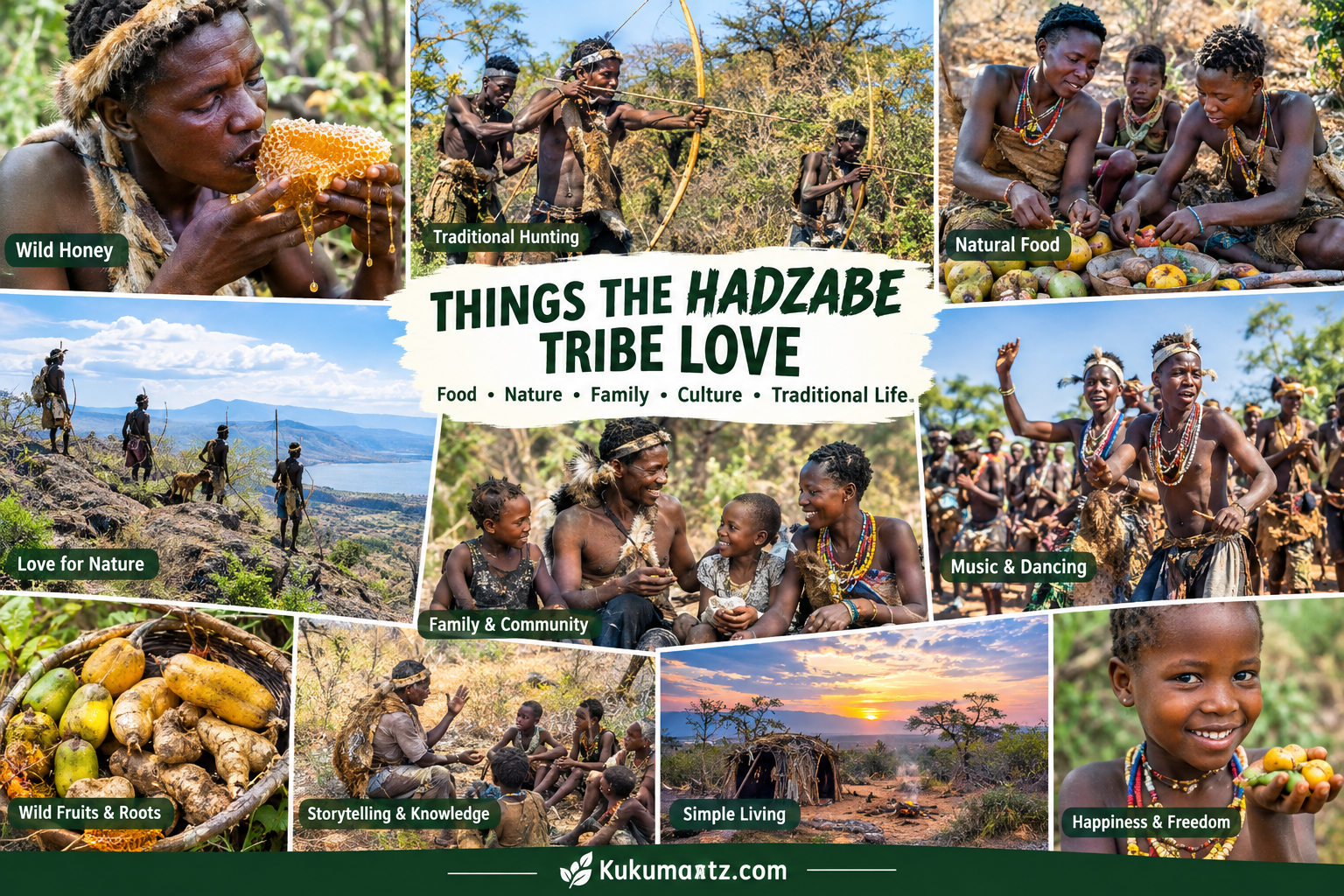
Discover the things the Hadzabe tribe love, including traditional foods, wild honey, hunting, nature, family, music, storytelling, and cultural traditions in Tanzania.
The Hadzabe are one of Tanzania’s most interesting Indigenous groups. They have a unique language and lifestyle and a close relationship to nature and a strong cultural identity. The Hadzabe are primarily located around Lake Eyasi in northern Tanzania and have preserved much of their traditional way of life in spite of the encroachment of the modern world.
The question of what the Hadzabe tribe love goes beyond food or entertainment. They live in close connection to nature, family, community, hunting, gathering, storytelling and cultural traditions.
In this article we look at some of the things that the Hadzabe people traditionally value and enjoy in their daily lives.
1. Living Close to Nature
One of the most important aspects of Hadzabe life is their relationship with nature.
The Hadzabe traditionally depend heavily on the natural environment for food, materials, medicine, and other necessities. The bush provides fruits, roots, honey, tubers, and other wild foods, while wildlife has traditionally been an important source of meat.
For many Hadzabe families, the natural environment is not simply a place where they live. It is an essential part of their culture and identity.
Their knowledge of plants, animals, water sources, tracks, and seasonal changes has been passed from one generation to another.
2. Traditional Hunting
Hunting has historically been an important part of Hadzabe life, particularly among men.
Traditional Hadzabe hunters are known for their knowledge of the bush and their ability to follow animal tracks. They traditionally use bows and arrows, demonstrating considerable skill and patience.
Hunting is not simply about obtaining meat. It is also connected to knowledge, cooperation, cultural practices, and the transmission of skills between generations.
Young boys can learn hunting-related skills from older members of the community, including how to understand animal movements, recognize tracks, and move through the bush.
Today, hunting practices and access to wildlife can vary because of conservation regulations, land-use changes, and other modern pressures.
3. Wild Honey
Honey is one of the foods traditionally appreciated by the Hadzabe.
The Hadzabe have extensive knowledge of wild bees and their surroundings. Finding honey can require considerable knowledge of the environment and an understanding of where bees are likely to build their nests.
Wild honey provides a valuable source of natural energy and is traditionally collected from the bush.
Honey gathering also illustrates the Hadzabe's remarkable environmental knowledge. Their ability to identify bee colonies and locate natural resources demonstrates how closely their traditional lifestyle is connected to the ecosystem around them.
4. Wild Fruits and Other Natural Foods
The Hadzabe traditionally enjoy a variety of foods collected from the natural environment.
Depending on the season and location, these can include wild fruits, roots, tubers, berries, and other edible plants. Women traditionally play an important role in gathering many plant foods.
Gathering requires detailed knowledge of which plants are edible, when they are available, and where they can be found.
This traditional food system has helped the Hadzabe survive in a challenging environment for generations.
5. Meat from the Bush
Wild meat has traditionally been an important component of the Hadzabe diet.
Successful hunting can provide meat that is shared within the community. Sharing food is an important social practice and helps strengthen relationships among family members and community members.
Rather than viewing food only as an individual possession, traditional Hadzabe society places considerable importance on cooperation and sharing.
6. Spending Time With Family
Family and social relationships are important in Hadzabe communities.
Daily life often involves spending time together, preparing food, talking, caring for children, and participating in community activities.
Children learn many practical and cultural skills by observing older members of the community.
This informal education is an important part of traditional Hadzabe culture because knowledge about hunting, gathering, nature, social relationships, and cultural practices can be passed from one generation to the next.
7. Storytelling and Sharing Knowledge
Storytelling is another important part of traditional community life.
Stories can entertain people while also communicating knowledge about the environment, social relationships, history, and cultural values.
Older members of a community can play an important role in passing knowledge to younger generations through conversation and storytelling.
For visitors interested in Hadzabe culture, listening to community members explain their own experiences can provide a much deeper understanding than simply observing their activities.
8. Traditional Music and Dancing
Music, singing, and dancing are also important expressions of Hadzabe culture.
Traditional performances can bring people together during social and cultural occasions. Singing and dancing provide opportunities for community members to express themselves, celebrate, and strengthen social connections.
The sounds, movements, and rhythms associated with Hadzabe cultural performances are distinctive and form an important part of their cultural heritage.
9. Traditional Games and Social Activities
Hadzabe communities also have traditional games and recreational activities.
Young people can participate in activities that develop physical skills, coordination, teamwork, and confidence. Some activities are connected to skills that have historically been useful in everyday life.
Games and informal competitions can also create opportunities for young people to spend time together and strengthen friendships.
10. Freedom and Independence
The concept of freedom is particularly interesting when discussing traditional Hadzabe life.
Historically, Hadzabe communities have had a relatively mobile lifestyle, allowing families to move according to the availability of water, food, and other natural resources.
This way of life differs considerably from modern urban lifestyles, where people are often tied to permanent houses, jobs, schools, and infrastructure.
The Hadzabe's traditional lifestyle has therefore been closely associated with independence and flexibility.
11. Respect for the Environment
Another thing closely associated with Hadzabe culture is extensive knowledge of the environment.
Generations of experience have given the community knowledge about animals, plants, seasons, water sources, and landscapes.
This knowledge is valuable not only for obtaining food but also for understanding how to survive in the environment.
However, it is important not to romanticize Indigenous communities or assume that every Hadzabe person lives exactly as their ancestors did. Hadzabe communities, like all societies, are changing over time.
12. Sharing Food With Others
Food sharing is an important part of traditional Hadzabe social life.
When food is obtained, it can be shared among relatives and other members of the community. Sharing contributes to social cooperation and helps build relationships.
This practice reflects a broader cultural emphasis on community rather than extreme individualism.
For the Hadzabe, food can therefore have social importance in addition to its nutritional value.
13. Spending Time Outdoors
Outdoor life is naturally an important part of traditional Hadzabe culture.
Walking through the bush, searching for food, hunting, gathering, collecting honey, looking for water, and moving between locations can all involve spending significant amounts of time outside.
For someone accustomed to city life, this lifestyle may appear very different. For the Hadzabe, however, the bush has traditionally been an important source of food, knowledge, culture, and livelihood.
14. Traditional Skills
The Hadzabe possess a wide range of traditional skills that have developed through generations of experience.
These include making and using bows and arrows, identifying edible plants, tracking animals, collecting honey, recognizing useful trees and plants, making fires, and navigating natural environments.
Such knowledge represents an important part of their cultural heritage.
Teaching these skills to younger generations helps preserve knowledge that might otherwise disappear as lifestyles change.
15. Cultural Identity
Perhaps one of the most important things the Hadzabe value is their cultural identity.
Their language, traditional practices, social organization, food systems, music, hunting knowledge, and relationship with the environment all contribute to a distinctive cultural heritage.
The preservation of this identity is increasingly important as modernization, land pressures, education, tourism, and economic changes influence communities around Lake Eyasi.
Why People Are Interested in Hadzabe Culture
Hadzabe culture attracts interest from researchers, travelers, photographers, filmmakers, and people interested in Indigenous societies because it provides an opportunity to learn about a way of life that differs significantly from modern urban society.
However, it is important to approach Hadzabe culture respectfully. The Hadzabe are not simply a historical curiosity or tourist attraction. They are a living community whose members have their own aspirations, challenges, choices, and perspectives.
When learning about the Hadzabe, the best approach is to listen to their voices and recognize that individual experiences can differ.
Frequently Asked Questions About the Hadzabe Tribe
What food do the Hadzabe traditionally love?
Traditional Hadzabe foods include wild meat, honey, fruits, roots, tubers, and other foods obtained from the natural environment. The exact foods available depend on the season and location.
Where do the Hadzabe live?
The Hadzabe primarily live in northern Tanzania, particularly around the Lake Eyasi region.
Do the Hadzabe still hunt?
Hunting remains an important part of Hadzabe cultural identity, although contemporary hunting practices are influenced by wildlife laws, conservation policies, land access, and changing economic conditions.
What are the Hadzabe famous for?
The Hadzabe are particularly known for their Indigenous language, traditional hunting and gathering lifestyle, knowledge of the natural environment, bow-and-arrow skills, and distinctive cultural traditions.
Do the Hadzabe eat honey?
Yes. Wild honey has traditionally been an important and valued food among the Hadzabe.
Why is nature important to the Hadzabe?
Nature has traditionally provided food, water, materials, medicine, and other resources. Consequently, knowledge of the natural environment is an important part of Hadzabe cultural knowledge.
Final Thoughts
The things the Hadzabe traditionally love are closely connected to their environment and community. From wild honey and natural foods to hunting, storytelling, music, family, traditional skills, and spending time outdoors, many aspects of Hadzabe life reflect a deep relationship with the natural world.
Their culture is a valuable part of Tanzania's Indigenous heritage. Learning about the Hadzabe can help people appreciate the diversity of human cultures and the importance of protecting Indigenous knowledge and cultural identity.
At the same time, the Hadzabe should be understood as a living and changing community. Modern education, technology, tourism, government policies, economic opportunities, and environmental changes continue to influence their lives.
Understanding their traditions while respecting their present-day choices is essential when discussing the Hadzabe people and their unique cultural heritage.