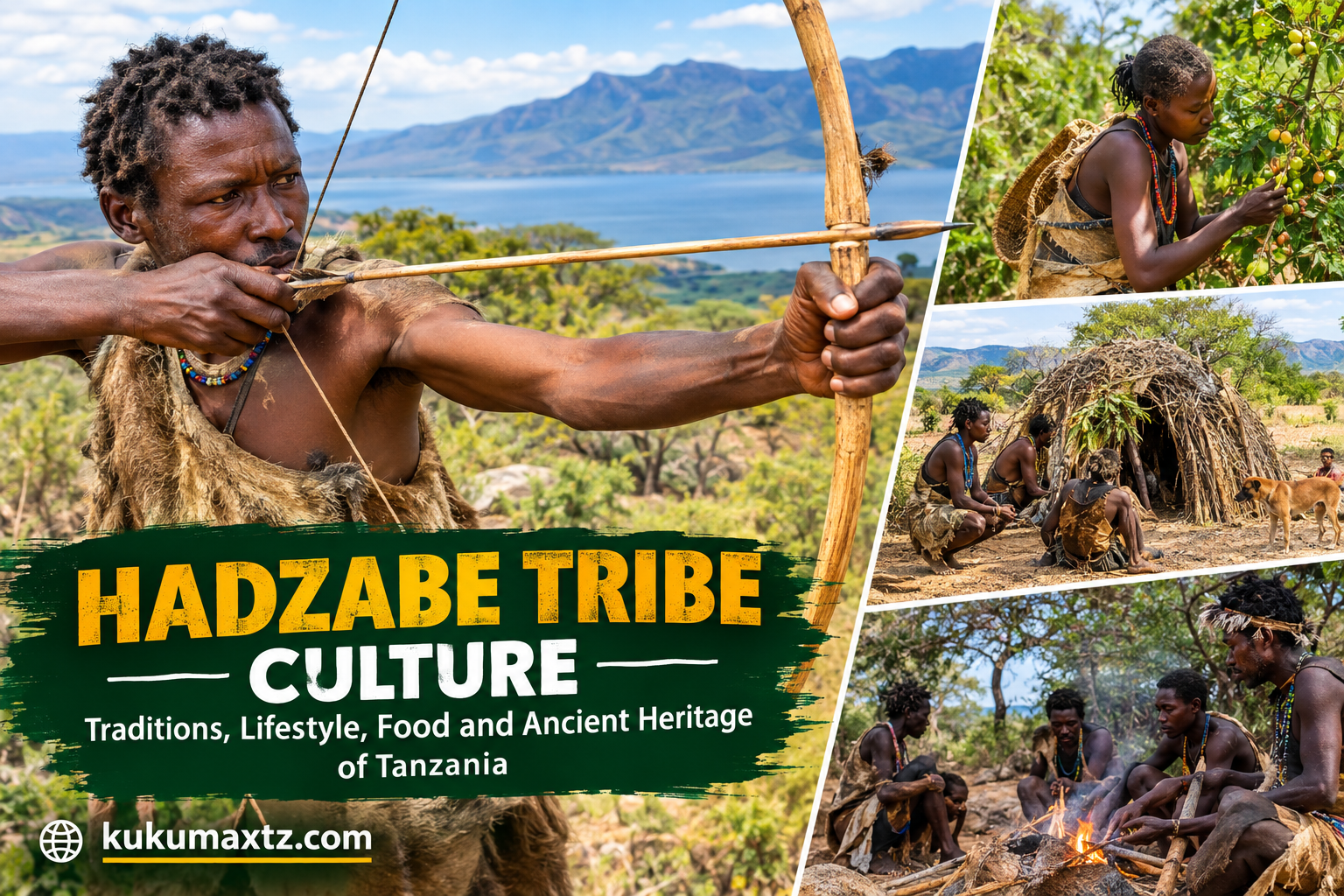
Discover Hadzabe tribe culture in Tanzania, including traditional hunting, gathering, food, language, beliefs, family life, music, and Indigenous heritage around Lake Eyasi.
The Hadzabe tribe culture is one of the most distinctive and fascinating indigenous cultures in Tanzania. The Hadzabe people, also known as the Hadza, have traditionally lived around Lake Eyasi in northern Tanzania, where their communities have maintained a close relationship with the natural environment for generations.
Unlike many modern societies, traditional Hadzabe life has historically depended heavily on hunting, gathering wild foods, social cooperation, traditional knowledge, and movement through the bush. Their culture provides an important example of how human communities can adapt to and live within a challenging natural environment.
This article explores the Hadzabe tribe culture, including their traditional lifestyle, hunting and gathering practices, language, family life, beliefs, food, clothing, traditional skills, and the challenges facing their communities today.
Who Are the Hadzabe?
The Hadzabe are an Indigenous people of northern Tanzania. Their traditional homeland is concentrated around the Lake Eyasi region, particularly in areas of Arusha and Manyara regions.
The Hadzabe are widely known for maintaining many aspects of a traditional hunter-gatherer lifestyle. Their communities have historically relied on naturally available resources rather than large-scale agriculture or livestock production.
The Hadzabe population is relatively small compared with many other ethnic groups in Tanzania. Because of this, their language and cultural traditions are considered an important part of Tanzania's cultural heritage.
One of the most recognizable characteristics of traditional Hadzabe society is its strong connection with the environment. Knowledge about plants, animals, water sources, seasons, and landscapes has traditionally been essential for everyday survival.
Traditional Hadzabe Lifestyle
Traditional Hadzabe life is closely connected to the natural environment.
Historically, many Hadzabe groups moved between different areas depending on the availability of food and water. Rather than depending on permanent agricultural settlements, traditional communities could relocate when local resources became limited.
This lifestyle required extensive knowledge of the surrounding landscape. People needed to understand where different fruits, roots, tubers, honey, and animals could be found throughout the year.
The traditional lifestyle also encouraged cooperation. Members of the community shared knowledge and resources, while different people contributed to activities such as hunting, gathering, preparing food, caring for children, and maintaining camps.
Although modern changes have affected Hadzabe communities, aspects of this traditional way of life remain important to Hadzabe identity.
Hadzabe Hunting Traditions
Hunting is one of the best-known aspects of traditional Hadzabe culture.
Traditionally, Hadzabe men have hunted a variety of wild animals using bows, arrows, and other locally produced tools. Hunting requires patience, physical ability, detailed knowledge of animal behavior, and an understanding of the landscape.
Traditional Hadzabe bows and arrows are particularly important cultural tools. Hunters have historically made and maintained their own equipment, developing skills that can be passed from one generation to another.
Hunting is not simply a source of food. It is also connected to cultural knowledge and social relationships.
Young people can learn by observing experienced hunters. Through this process, knowledge about tracking animals, recognizing footprints, identifying sounds, understanding weather conditions, and navigating the bush can be transmitted across generations.
Today, however, hunting practices are affected by wildlife regulations, land-use changes, conservation policies, and the increasing influence of modern economic activities.
Hadzabe Gathering and Wild Foods
Gathering is another major component of traditional Hadzabe subsistence.
Women have traditionally played an important role in collecting wild foods. Depending on the season and location, these foods may include fruits, roots, tubers, seeds, and other edible plants.
Gathering requires detailed knowledge of the environment. People must know which plants are edible, when they are available, where they grow, and how they should be prepared.
This traditional ecological knowledge is one of the most valuable elements of Hadzabe culture.
Wild foods can also provide important nutritional resources during periods when hunting is less successful.
The Importance of Honey
Honey has a special place in traditional Hadzabe food culture.
Hadzabe honey hunters have traditionally searched for wild bee colonies in trees and other natural locations. Finding honey requires knowledge of bees, trees, seasons, and the landscape.
Honey can provide a concentrated source of energy and is highly valued as a natural food.
Traditional honey gathering also demonstrates the close relationship between Hadzabe communities and their environment. The ability to identify suitable trees and locate bee colonies is a skill that requires experience.
Hadzabe Traditional Food
Traditional Hadzabe food has historically been based on naturally available resources.
Depending on location and season, traditional foods can include:
- Wild honey
- Wild fruits
- Tubers and roots
- Seeds and nuts
- Wild plants
- Meat obtained through hunting
- Other naturally available foods
Food preparation is an important part of daily community life. Sharing food can also strengthen social relationships and cooperation.
Modern foods are increasingly accessible in areas where Hadzabe communities interact with markets, schools, towns, and other communities. Nevertheless, traditional foods remain an important part of cultural identity.
Hadzabe Language
The Hadzabe speak the Hadzane language, which is an important part of their cultural identity.
Language carries knowledge about the environment, social relationships, traditions, stories, and everyday experiences. For Indigenous communities, protecting a language can therefore be closely connected to protecting cultural heritage.
Hadzane is particularly notable for its extensive use of click sounds. These sounds are among the features that make the language distinctive.
The continued transmission of Hadzane to younger generations is important for maintaining cultural knowledge and identity.
Hadzabe Family and Community Life
Traditional Hadzabe society places considerable importance on community relationships.
People traditionally live in relatively small social groups, with cooperation playing an important role in daily life. Relationships between family members, friends, and other community members can influence how food, childcare, knowledge, and responsibilities are shared.
Children learn many cultural skills through observation and participation.
Instead of learning everything through formal classroom instruction, traditional knowledge can be transmitted through everyday activities. Young people may learn about plants by accompanying experienced gatherers or learn hunting and tracking skills by observing experienced hunters.
This informal education is a fundamental feature of traditional Indigenous knowledge.
Hadzabe Traditional Shelters
Traditional Hadzabe shelters are generally simple structures made from locally available materials.
Their design reflects the traditional mobile lifestyle. Shelters can be constructed relatively quickly using branches, grass, and other materials found in the surrounding environment.
The simplicity of these shelters demonstrates an important principle of traditional Hadzabe life: making practical use of available natural resources.
Modern housing is becoming increasingly common in some Hadzabe communities, particularly where people have established more permanent settlements.
Hadzabe Clothing and Appearance
Traditional Hadzabe clothing has historically been practical and suited to the local environment.
Animal skins were traditionally used for clothing and other purposes. Today, however, many Hadzabe people also wear commercially produced clothing purchased or obtained through interaction with neighboring communities and markets.
Traditional accessories, hairstyles, ornaments, and other forms of personal expression can also contribute to cultural identity.
It is important to recognize that Hadzabe culture is not frozen in the past. Like other societies, Hadzabe communities continue to adapt to social, economic, environmental, and technological changes.
Hadzabe Music, Dance and Storytelling
Music, dancing, storytelling, and social gatherings are important ways through which cultural knowledge can be expressed and transmitted.
Traditional songs can communicate experiences, relationships, history, and community values. Storytelling provides another way for older generations to pass knowledge to younger people.
Traditional cultural performances can also strengthen community identity.
For visitors interested in Hadzabe culture, observing these activities respectfully can provide insight into the importance of community and oral traditions.
Hadzabe Traditional Beliefs
Traditional Hadzabe beliefs are closely associated with nature, spiritual concepts, and the surrounding environment.
Beliefs and practices can vary between individuals and communities, and it is important not to assume that every Hadzabe person follows exactly the same traditions.
Traditional spiritual practices may involve concepts relating to nature, ancestors, dreams, health, and relationships between humans and the natural world.
Modern religious and cultural influences have also reached Hadzabe communities, meaning that contemporary beliefs may include a mixture of traditional and newer influences.
Equality and Social Cooperation
One notable feature often associated with traditional Hadzabe society is the importance of sharing and social cooperation.
In a hunter-gatherer environment, cooperation can be essential because hunting success is unpredictable and food availability can change with seasons.
Sharing resources can therefore help strengthen social bonds and reduce the risks associated with food shortages.
Social relationships also provide support for childcare, food preparation, movement, and other everyday activities.
Traditional Knowledge of Nature
Perhaps one of the most valuable elements of Hadzabe culture is their detailed knowledge of the natural environment.
Traditional knowledge can include the identification of edible plants, medicinal plants, animal tracks, water sources, trees, insects, weather patterns, and seasonal changes.
This knowledge is developed over many years through direct experience.
For researchers interested in Indigenous knowledge and environmental adaptation, the Hadzabe provide an important example of a society whose traditional knowledge has developed through a close relationship with a specific ecosystem.
Hadzabe Children and Cultural Education
Children traditionally learn through participation.
A child may observe adults collecting food, preparing meals, making tools, caring for younger children, tracking animals, or performing other everyday activities.
Through repetition and observation, children gradually develop practical knowledge.
This form of education is different from formal schooling but can be highly sophisticated because it is directly connected to the environment in which people live.
Today, education systems are increasingly important for Hadzabe children, creating new opportunities while also raising questions about how Indigenous languages, traditions, and knowledge can be preserved.
Challenges Facing Hadzabe Culture Today
Hadzabe culture faces several challenges in the modern world.
Land pressure is one important issue. Changes in land use, agriculture, livestock keeping, conservation, tourism, and other economic activities can affect access to traditional territories and natural resources.
Climate variability can also influence the availability of water, plants, and wildlife.
Education, healthcare, markets, technology, and modern employment can provide important opportunities, but they can also contribute to changes in traditional lifestyles.
For this reason, cultural preservation requires more than simply documenting traditional practices. It also involves supporting Indigenous communities in determining how their culture and resources should be protected while accessing modern opportunities.
Why Hadzabe Culture Is Important
The Hadzabe are an important part of Tanzania's cultural diversity.
Their traditions demonstrate the value of Indigenous knowledge and provide insight into different ways humans have adapted to their environments.
Their knowledge of plants, animals, landscapes, weather, and natural resources is especially valuable in discussions about biodiversity and environmental conservation.
Preserving Hadzabe culture does not mean preventing change. Rather, cultural preservation can mean ensuring that Hadzabe people have the freedom and resources to maintain important aspects of their heritage while making their own choices about the future.
Responsible Tourism and Visiting the Hadzabe
Visitors interested in experiencing Hadzabe culture should approach communities with respect.
Tourism can create economic opportunities, but visitors should remember that Hadzabe people are not simply a tourist attraction. They are living communities with their own rights, traditions, and contemporary challenges.
Responsible visitors should:
- Ask permission before taking photographs.
- Respect local customs.
- Avoid treating cultural activities as entertainment only.
- Support ethical and community-benefiting tourism.
- Avoid taking cultural objects without permission.
- Listen to local guides and community members.
- Avoid making assumptions about how every Hadzabe person lives.
Respectful tourism can help create cultural awareness while providing economic benefits to local communities.
Frequently Asked Questions About Hadzabe Tribe Culture
Where do the Hadzabe live?
The Hadzabe traditionally live in northern Tanzania, particularly around the Lake Eyasi area.
What is the Hadzabe tribe known for?
The Hadzabe are widely known for their traditional hunter-gatherer lifestyle, distinctive Hadzane language, hunting and gathering skills, traditional ecological knowledge, and close relationship with the natural environment.
What language do the Hadzabe speak?
The Hadzabe traditionally speak Hadzane, a distinctive language known for its click sounds.
What do the Hadzabe eat?
Traditional Hadzabe foods include wild honey, fruits, roots, tubers, seeds, plants, and meat obtained through hunting, although diets vary and modern foods are also increasingly consumed.
Do the Hadzabe still hunt?
Hunting remains culturally significant, but contemporary hunting practices vary and are affected by wildlife laws, conservation policies, land access, and changing lifestyles.
Are all Hadzabe people hunter-gatherers?
No. While hunting and gathering are central to traditional Hadzabe identity, contemporary Hadzabe communities have diverse lifestyles. Some people interact with markets, education, agriculture, wage employment, tourism, and other modern economic activities.
Why is Hadzabe culture important?
Hadzabe culture is important because it represents a distinctive Indigenous heritage and contains extensive traditional knowledge about the environment, food resources, wildlife, plants, and social cooperation.
Conclusion
The Hadzabe tribe culture represents an important part of Tanzania's Indigenous heritage. Their traditional knowledge of hunting, gathering, honey collection, plants, wildlife, language, storytelling, and community cooperation has developed over generations.
Although modernization and environmental changes are transforming aspects of Hadzabe life, many cultural traditions remain important to their identity.
Understanding Hadzabe culture requires looking beyond the popular image of hunters in the African bush. The Hadzabe are contemporary people whose communities are navigating education, land rights, conservation, economic change, technology, and cultural preservation.
Protecting their heritage should therefore involve respect for their traditions, recognition of their rights, and support for their ability to make decisions about their own future.