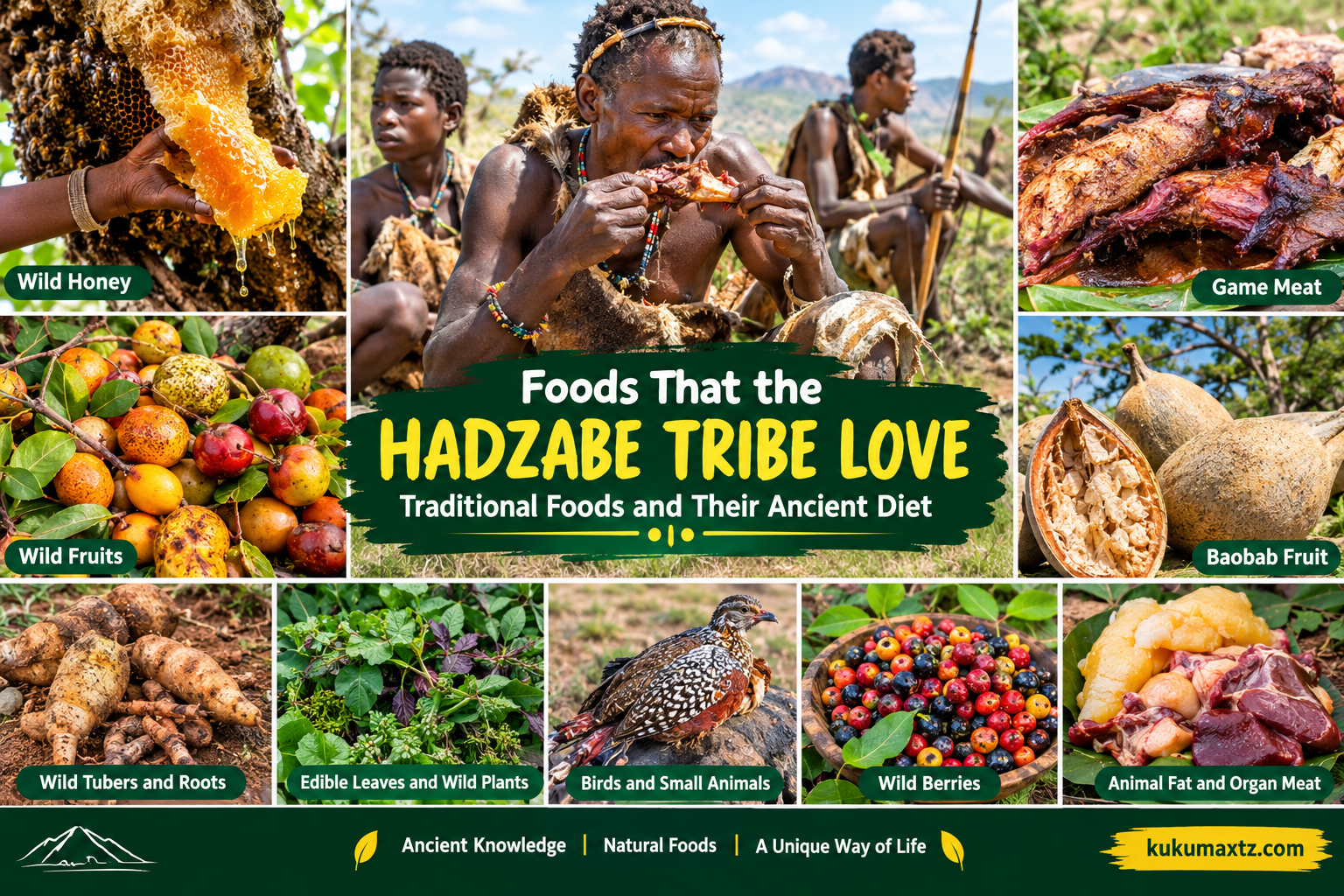
Discover the traditional foods of the Hadzabe tribe in Tanzania, including wild honey, game meat, wild fruits, baobab, roots, tubers, berries, and other foods.
The Hadzabe tribe of Tanzania is one of the most distinctive hunter-gatherer peoples of East Africa. For generations the Hadzabe people have relied on the natural environment around them for food. Their traditional diet is deeply entwined with hunting, gathering, seasonal variation and a detailed knowledge of wild plants and animals.
The Hadzabe’s traditional diet is not based on supermarkets, farms and processed foods as in modern diets, but on foods collected or hunted directly from the surrounding bush and woodland. They are important sources of protein, carbohydrates, natural sugars, fats, vitamins and minerals.
In this paper we explore some of the traditional foods important in the Hadzabe diet and how hunting and gathering influence community food choices.
1. Wild Honey
Wild honey is one of the most valued foods in the traditional Hadzabe diet. The Hadzabe are well known for their skills in locating and collecting honey from wild bees.
Honey provides a concentrated source of natural carbohydrates and energy. It can be eaten directly from the honeycomb, and the honeycomb itself may also be consumed.
Finding wild honey requires extensive knowledge of the environment. Hadzabe honey collectors can identify areas where bees are likely to establish colonies and may use traditional techniques to reach hives located in trees.
Honey is particularly valuable because it provides quick energy and can be available even when some other food resources are difficult to find.
2. Wild Game Meat
Hunting is an important part of traditional Hadzabe food culture. Hadzabe hunters have traditionally pursued a variety of wild animals, depending on the environment, season, and availability.
Game meat can provide a valuable source of protein and fat. Animals hunted traditionally may include different species of antelope and other small or medium-sized wildlife.
Hunting also requires considerable knowledge of animal behavior, tracks, vegetation, and the landscape. Traditional bows and arrows are closely associated with Hadzabe hunting culture.
For the Hadzabe, hunting is not simply about obtaining meat. It is also connected to cultural knowledge, cooperation, traditional skills, and the transmission of knowledge between generations.
3. Wild Fruits
Wild fruits are another important part of the traditional Hadzabe diet. The woodland environment around Hadzabe communities provides various naturally occurring fruits that can be gathered when they are in season.
Wild fruits can provide natural sugars, water, fiber, vitamins, and minerals. Because different fruits become available at different times of the year, seasonal knowledge is essential.
Hadzabe gatherers must be able to recognize edible plants and fruits and understand where they are likely to be found. This knowledge is traditionally passed from older generations to younger members of the community.
4. Baobab Fruit
The baobab tree is an iconic part of the African landscape and can also provide useful food resources. Its fruit contains a dry, nutritious pulp that can be eaten or prepared in different ways.
Baobab fruit is known for containing vitamin C and other nutrients. Its naturally distinctive flavor makes it an important wild food in areas where baobab trees grow.
For communities with extensive knowledge of wild food resources, trees such as baobab can be particularly valuable because they provide food without requiring conventional agricultural cultivation.
5. Wild Tubers and Roots
Tubers and edible roots are important sources of carbohydrates in many traditional hunter-gatherer diets, including among the Hadzabe.
Hadzabe gatherers have extensive knowledge of plants growing in their environment. They can identify plants that provide edible underground parts and understand where and when these foods are most likely to be available.
Roots and tubers can be especially useful because they may remain available during periods when fruits or other seasonal foods are scarce.
Collecting them can require considerable physical effort because the edible portion is often located beneath the soil.
6. Edible Leaves and Other Wild Plants
The Hadzabe environment contains numerous wild plants that can be used as food. Depending on the species and season, edible leaves, shoots, seeds, and other plant parts may contribute to the traditional diet.
Knowledge of edible and potentially harmful plants is extremely important. Traditional food gathering is therefore based on generations of environmental knowledge rather than simply picking random plants from the bush.
This knowledge represents an important part of Hadzabe cultural heritage.
7. Birds and Small Animals
In addition to larger game, traditional Hadzabe hunters may pursue birds and smaller animals.
Small animals can provide protein and may be particularly useful when larger game is difficult to locate. Hunting techniques can vary according to the animal being pursued and the surrounding environment.
The ability to identify tracks, sounds, nests, feeding areas, and other signs of wildlife is an important component of traditional Hadzabe hunting knowledge.
8. Wild Berries and Seasonal Foods
Berries and other seasonal wild foods can supplement the Hadzabe diet. Their availability depends heavily on rainfall, temperature, vegetation, and the time of year.
Seasonality plays a major role in traditional hunter-gatherer food systems. Rather than eating exactly the same foods every day, people make use of whatever resources are available in their environment.
This creates a flexible food system based on detailed knowledge of seasonal changes.
9. Animal Fat and Organ Meat
When an animal is successfully hunted, different parts can provide nutritional value. Meat, fat, and certain edible organs may all contribute to the diet.
Animal fat can be particularly valuable because it provides a concentrated source of energy. In traditional subsistence systems, maximizing the nutritional value of a successful hunt is important.
The sharing of meat can also have social and cultural significance within the community.
10. Traditional Foods Depend on the Environment
One of the most interesting aspects of the Hadzabe diet is that it is strongly connected to the surrounding ecosystem.
The foods available to Hadzabe communities can change according to the season. During one period, wild fruits and honey may be particularly important, while at another time hunters may focus more heavily on available game or gather different roots and tubers.
This relationship with the environment has helped the Hadzabe develop extensive knowledge of local plants, animals, water sources, and seasonal patterns.
How the Hadzabe Find Their Food
Traditional Hadzabe food gathering involves two major activities: hunting and gathering.
Men have traditionally been strongly associated with hunting, particularly the hunting of wild game, while women have traditionally played an important role in gathering plant foods, fruits, roots, and other resources. However, these roles should not be understood as completely fixed, because daily activities can vary between individuals, families, and communities.
Hunting and gathering require knowledge that is learned from an early age. Children can learn to recognize plants, animal tracks, trees, insects, and other features of their environment by observing and participating with older members of the community.
Why Hadzabe Food Culture Is Important
Hadzabe traditional food culture is more than a list of foods. It represents a relationship between people and their environment that has developed over many generations.
Their knowledge of wild foods demonstrates the importance of understanding local ecosystems. Traditional hunting and gathering also provide insights into how human communities can adapt their food practices to changing environmental conditions.
However, it is important not to romanticize the Hadzabe lifestyle. Like many indigenous communities, the Hadzabe face social, economic, environmental, and land-related changes that can influence access to traditional food resources.
Modern foods and changing lifestyles have also become part of everyday life for many Hadzabe people. Therefore, the traditional diet should be understood as an important part of Hadzabe heritage rather than assuming that every Hadzabe person eats only wild foods today.
Final Thoughts
The traditional Hadzabe diet reflects a deep understanding of Tanzania’s natural environment. Wild honey, game meat, fruits, baobab, roots, tubers, berries, birds, and other wild foods have played important roles in their food culture.
What makes the Hadzabe food tradition particularly fascinating is not only the foods themselves, but the knowledge required to find, identify, collect, and prepare them.
For anyone interested in African culture, traditional foods, indigenous knowledge, or the history of hunter-gatherer societies, the Hadzabe provide an important example of how human communities can develop sophisticated relationships with their natural surroundings.
Preserving knowledge about traditional Hadzabe foods can help future generations understand the cultural heritage, environmental knowledge, and traditional practices of one of Tanzania’s most distinctive indigenous communities.